Hermit crabs have been bred in captivity, but successful captive breeding is rare and far more complex than most keepers realize. This page documents the breeding process, larval stages, and early home breeding work that helped shape what we know about captive-bred land hermit crabs today.
This is not a beginner guide to breeding pet hermit crabs. It is a reference page for understanding what successful captive breeding actually involves, why it is so difficult, and how early keepers like Stu Wools Cobb helped document the process.

What This Page Covers
- why captive breeding is still uncommon
- how hermit crabs reproduce
- what successful captive breeding requires
- larval development and settlement
- early home breeding efforts
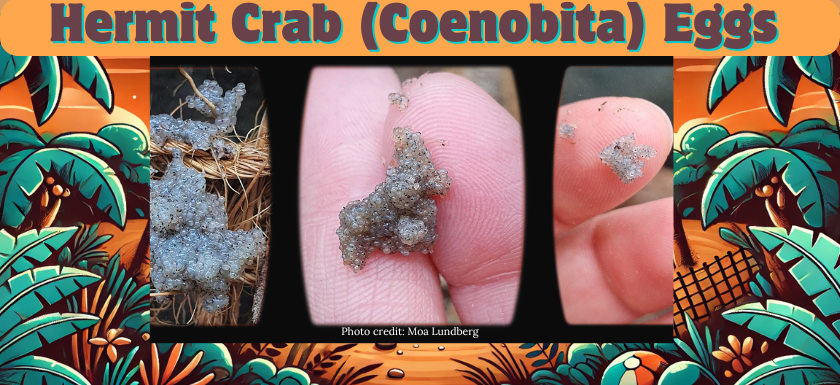
photo by Moa Lundberg
Captive Breeding at a Glance
Mating → Egg Carrying → Larval Release → Zoeal Stages → Megalopa → Settlement → First Land Molt → Juvenile Crab
Mating Is Not the Same as Breeding
Mating, egg carrying, larval release, settlement, and successful juvenile survival are all separate stages of the breeding process. Reaching one does not guarantee the next.
Many keepers have observed mating behavior and some have reported egg carrying or larval release. Very few have successfully raised those larvae through settlement into healthy terrestrial juveniles.
This is why mating alone is not considered successful captive breeding.
How Hermit Crabs Reproduce
Successful captive breeding begins long before larvae ever enter saltwater. Mating, fertilization, and spawning are the first visible stages of reproduction, but they are only the beginning of the breeding cycle. These early stages are rarely observed clearly in captivity and even more rarely documented.

Helfman 1997a: described the copulatory behaviour of B. latro from observation of a single event. Both male and female crabs were in the intermolt phase during copulation. The male approaches the female slowly, clasps the dorsal meri of the chelipeds, and quickly moves forward to turn the female onto her back. Abdomens are extended, the male deposits the spermataphore, and the pair disengages.
Photo by Stacy Griffith Coenobita clypeatus in mating position

Helfman 1997a: described the copulatory behaviour of B. latro from observation of a single event. Both male and female crabs were in the intermolt phase during copulation. The male approaches the female slowly, clasps the dorsal meri of the chelipeds, and quickly moves forward to turn the female onto her back. Abdomens are extended, the male deposits the spermataphore, and the pair disengages.


Ovigerous females may be taking shelter at other points along this beach showing a cryptic habit during daylight and active at night as C compressus, a common occurrence observed among ovigerous females of crustaceans; Particularly for C. scaevola and other coenobitids showed either daily or season migrations depending upon rainfall. Also, spawning females of C. clypeatus presented unusual pattern since they did not enter the water, but move toward the sea at low tide to drop or fling their eggs onto the wet rocks.Shell utilization by the land hermit crab Coenobita scaevola from Wadi El-Gemal, Red Sea by Salam WS, Mantellato FL & Hanafy MH
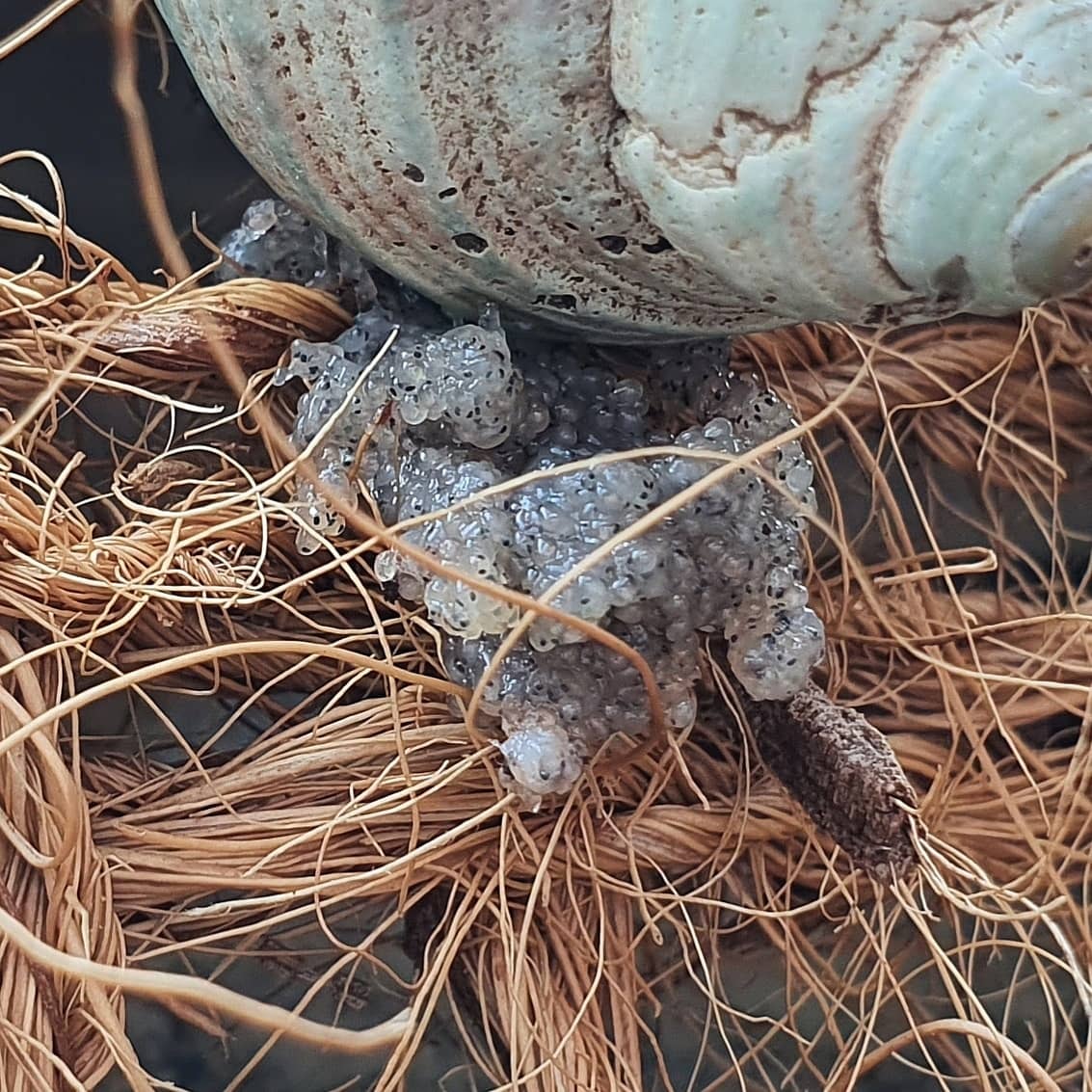
Photo by Moa Lundberg

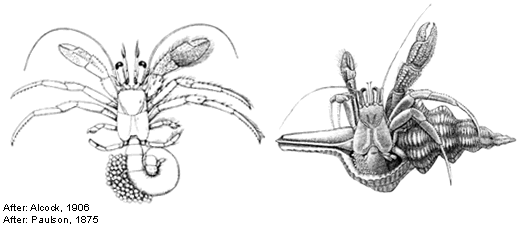
Drawing of a gravid female by Alcock and Paulson

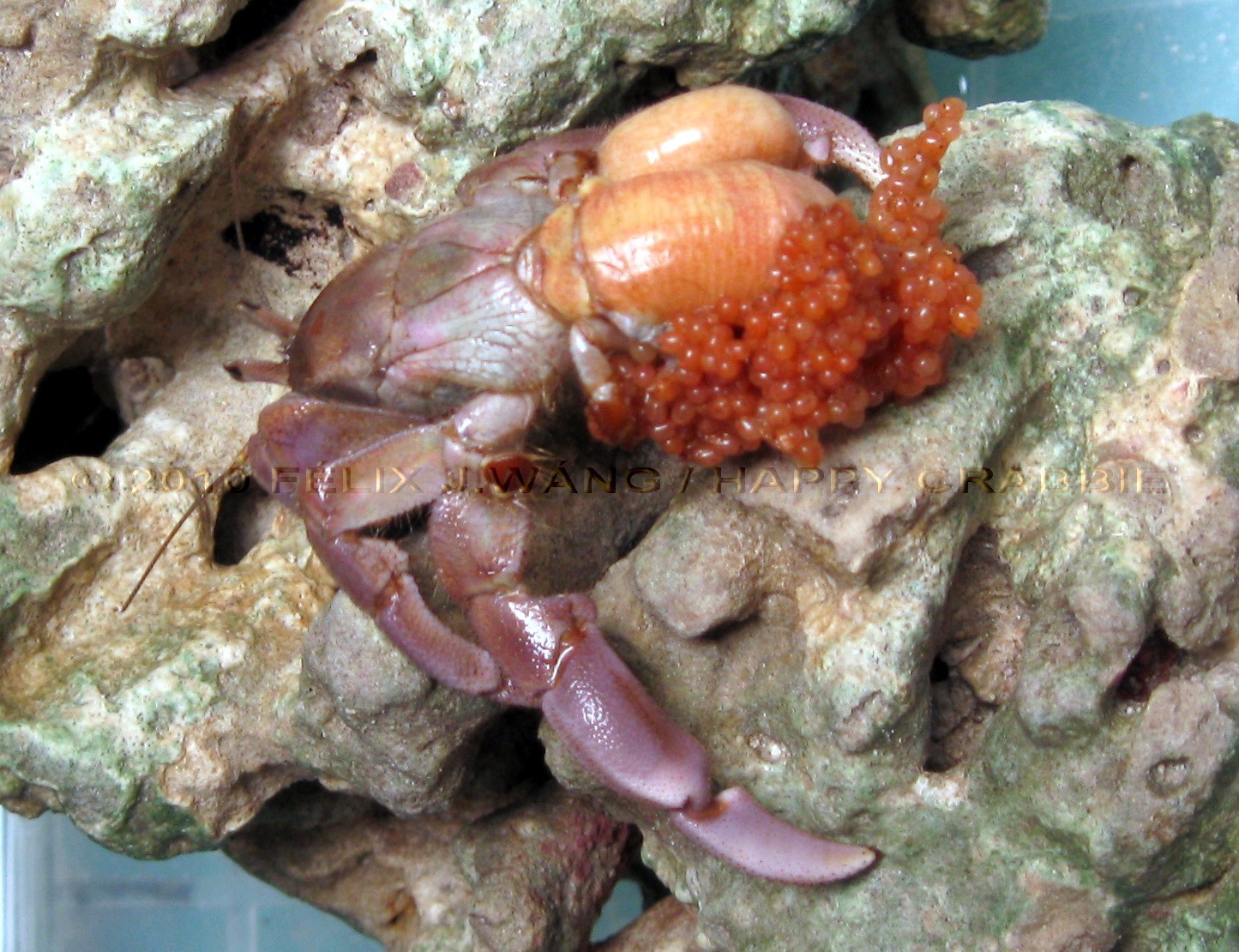
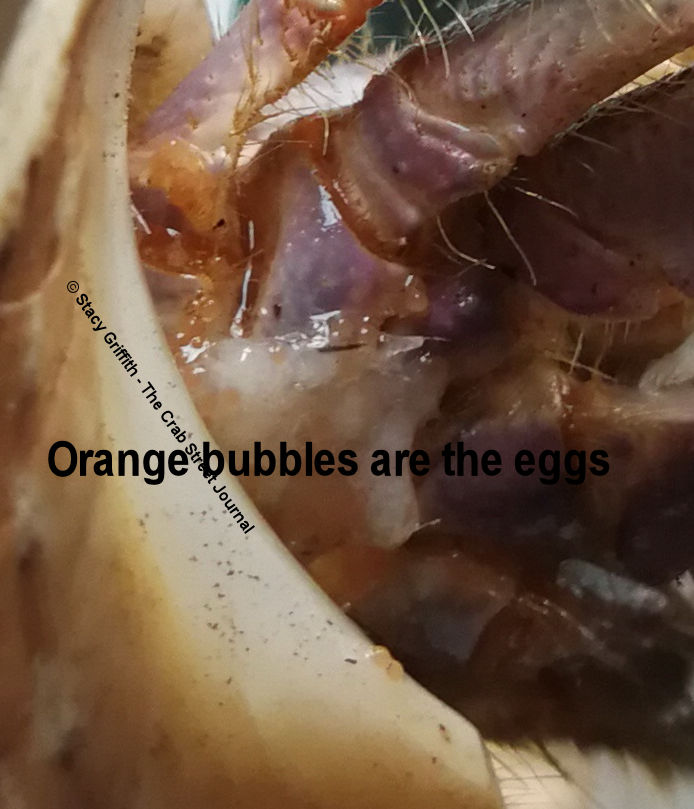
“A female crab attaches her eggs to the fine setae on her pleopods using a glue like substance.” Fox, Sue. 2000
Gravid Coenobita photo by Felix Adhi Pramano
These early reproductive stages are the most visible part of the breeding process, but they are not the most difficult. The greatest barrier to captive breeding begins after spawning, when the larvae enter the water column.
The Larval Stages
Land hermit crabs do not hatch as miniature land crabs. After the eggs are released into saltwater, the young hatch as free-swimming marine larvae called zoeae. This begins the most fragile and difficult part of the breeding cycle: the planktonic larval stage.
During this aquatic phase, the larvae remain fully marine and pass through multiple zoeal stages before reaching the megalopa stage. The exact number of zoeal molts varies by species and environmental conditions, but most Coenobita species pass through four to five zoeal stages before metamorphosis. In laboratory-reared Coenobita compressus, most larvae completed five zoeal stages before transitioning to megalopa, while some completed four.
Each zoeal stage is planktonic, delicate, and highly sensitive to temperature, salinity, water quality, and food availability. These larvae are not simply “babies in saltwater.” They are fully marine larval crustaceans that must survive repeated molts while suspended in the water column, feeding and developing through each stage. This is one of the primary reasons successful captive breeding is so difficult outside of dedicated larval systems.
After the final zoeal molt, the larvae transition into the megalopa stage. This is the intermediate form between the free-swimming larva and the first true juvenile crab. At this stage, the body begins to resemble a tiny hermit crab rather than a planktonic larva. Megalopae begin the transition from open-water development to benthic settlement and prepare for life on land.
The megalopa stage marks the beginning of the sea-to-land transition. As they mature, megalopae begin seeking shells, leave the water, and move onto damp sand to burrow and molt. After this molt, they emerge as the first juvenile crab stage: terrestrial, air-breathing, and structurally recognizable as a young land hermit crab.
This transition is where most breeding attempts fail. Getting larvae to hatch is only the beginning. The real challenge is successfully raising zoeae through multiple aquatic larval stages, supporting metamorphosis into megalopa, and then surviving the final transition from marine larva to terrestrial juvenile.
Why Species Matters
Species matters because larval development is not the same across Coenobita. Some species pass through a short, abbreviated larval pathway, while others require more zoeal stages and a longer planktonic period before reaching megalopa. That directly affects captive breeding difficulty because every additional day in the water column increases the demands for feeding, water quality, temperature stability, and survival through molts.
C. variabilis is the clearest example of abbreviated development, producing large larvae that pass through only two brief zoeal stages; Hamasaki et al. describe this as the shortest developmental pathway among the studied coenobitids. That shorter larval phase is why it is more practical for captive breeding work than species with longer pathways, such as C. cavipes or C. scaevola.

Larval stage counts and duration shown below reflect the most current published research and documented breeding data available for each species at the time of writing.

A visual representation of the larval stages of Coenobita brevimanus.
Source: Adapted from Hamasaki et al. (2014), larval development of Coenobita brevimanus described from laboratory-reared material.
Why Captive Breeding is Difficult
Captive breeding is difficult because mating is only the beginning. Getting eggs is not the hard part. The real challenge begins after the female releases her larvae into saltwater.
Land hermit crabs do not hatch as tiny terrestrial crabs. They hatch as fully marine planktonic larvae that must survive in saltwater through multiple fragile zoeal stages before they can ever begin the transition back to land. Each stage requires stable salinity, clean water, appropriate food density, successful molts, and consistent environmental conditions. A single failed molt, missed feeding window, or water quality shift can wipe out an entire brood.
This is where most breeding attempts fail.
The larval stage is the biggest barrier to captive breeding success because it demands an entirely different system than the one used to keep adult hermit crabs. Successfully breeding land hermit crabs requires more than a healthy crabitat. It requires a stable marine larval system capable of supporting delicate planktonic larvae through repeated molts and metamorphosis.
Even when larvae survive to megalopa, the most difficult transition is still ahead. At this stage they must begin the shift from marine larva to terrestrial juvenile: locating an appropriate shell, leaving the water, burrowing, and surviving the first land molt. This transition is one of the most fragile points in the entire breeding cycle and one of the most common points of failure.
Species also matters. Some Coenobita have relatively short larval cycles with fewer zoeal stages, while others remain planktonic much longer and require more molts before settlement. Every additional stage increases the demands on food, water quality, timing, and survival. This is one of the biggest reasons some species are significantly more practical for captive breeding than others.
Successful captive breeding requires more than breeding adults. It requires sustaining marine larvae, supporting metamorphosis, and surviving settlement into healthy terrestrial juveniles. That is why mating is common, egg carrying is possible, and true captive breeding remains rare.
Stu Wools Cobb and Early Home Breeding
Original content written by Vanessa Pike-Russell Thu, Oct. 12th, 2006, 10:40 pm Keeping and breeding land hermit crabs
Foreword:
Hello. My name is Vanessa Pike-Russell. Stu Wools-Cobb visited my website on land hermit crab care and emailed me after reading my caresheet on gender and reproduction. At the time it had been unheard of for land hermit crabs to have successfully reproduced in captivity and the resulting eggs raised to juvenile (air-breathing) stage of development.
A few emails, phone calls later, and Stu sent me a copy of his booklet that was created in part for his local aquarist society. Through his extensive background in breeding fish and raising brine shrimp he was able to raise the hermit crab zoea with the materials he had on hand (see pages 10-12) and fed them a diet rich in nutrients similar to those they would have access to in the intertidal pools of the wild. A steady routine of hand-feeding every two hours contributed to his success – and it is his desire to share his knowledge and success with other land hermit crab enthusiasts with the hope that others will obtain similar results.
Before you view this document, you are asked to be very mindful that it is for personal viewing only. Do not sell, re-sell, publish or distribute this booklet for commercial purposes. Any plagiarism of content contained within this booklet may result in legal action. All work remains the sole intellectual property of Stu Wools-Cobb and should not be used in any way without permission.
Stu Wools-Cobb has given written permission for Vanessa Pike-Russell of About Land Hermit Crabs (www.aboutlandhermitcrabs and http://users.tpg.com.au/vanessap/ ) permission to share this information on her personal site and on the magazine The Crab Street Journal of which she is a producer and webmaster. Any other use of this material is considered in breach of this agreement so please be very mindful of the terms on which it is shared.
What Successful Captive Breeding Actually Requires
Successful captive breeding requires far more than mating adults and favorable tank conditions. Adult care is only the starting point. The real barrier is sustaining marine larvae through repeated molts, successful settlement, and the transition to healthy terrestrial juveniles.
To complete the full breeding cycle in captivity, larvae must survive every stage between hatching and juvenile settlement: stable salinity, clean marine water, appropriate food density, successful molts, metamorphosis into megalopa, shell selection, settlement, and the first land molt. This is where most breeding attempts fail.

Raising larvae is not passive. Zoeae are delicate planktonic larvae, not miniature hermit crabs, and they require a dedicated marine larval system that can support feeding, water quality, and development through each stage. Getting larvae to hatch is only the beginning. Successfully raising them through settlement is the actual measure of captive breeding success.
Healthy adults still matter, because successful breeding begins with long-term biological stability. Adult hermit crabs must first survive long enough to mature, molt repeatedly, maintain access to preferred shells, and remain nutritionally stable in an environment that supports normal biological function over time.
Captive breeding is not triggered by one secret condition. It is the result of meeting all of their biological needs well enough, long enough, for normal reproductive behavior to become possible. Space, nutrition, shell access, stable heat and humidity, access to both fresh and marine salt water, and long-term health all contribute—but none of them remove the difficulty of raising the larvae.
That is what successful captive breeding actually requires: not just breeding adults, but sustaining every stage that follows.
Why Most Keepers Should Focus on Long-Term Care First
For most keepers, breeding should not be the goal. Long-term survival should.
Captive breeding is often treated as the ultimate sign of success in hermit crab keeping, but in practice it is one of the last outcomes of doing everything else well for a very long time. Healthy adults, stable conditions, proper nutrition, successful molts, and years of consistent care all come first.
Most hermit crabs in captivity never reach the point where breeding is even biologically possible—not because breeding is impossible, but because basic care is still the limiting factor.
Hermit crabs must first survive long enough to mature, molt repeatedly, maintain proper shell access, remain nutritionally stable, and live in conditions that support normal biological function over time. These are the real barriers in most captive systems, and they matter far more than breeding attempts.
A crab that cannot molt safely, cannot access preferred shells, or is still surviving on unstable heat, poor humidity, or inadequate nutrition is nowhere near breeding condition.
For most keepers, the better goal is not breeding. It is building the kind of stable, long-term care that makes normal biological behavior possible in the first place.
Breeding is not the starting point. It is the byproduct of doing everything else right first.
Why Wild-Caught Pressure Matters
Captive breeding matters because nearly every hermit crab sold in the pet trade is still taken from the wild.
Land hermit crabs are not farmed on a commercial scale. They are collected from their natural habitats, removed from coastal ecosystems, and funneled into the pet trade to meet demand. Every wild-caught hermit crab sold as a disposable souvenir or low-maintenance pet increases that pressure.
This is one of the reasons successful captive breeding matters far beyond hobby curiosity.
Captive breeding is not just about proving it can be done. It is one of the only meaningful paths toward reducing long-term dependence on wild harvest and building a more sustainable future for hermit crab keeping.
The more difficult captive breeding is, the more important that work becomes.
Supporting successful captive breeding does not just benefit the hobby. It helps reduce collection pressure on wild populations and challenges the assumption that hermit crabs must always be taken from the wild to be kept in captivity.
Additional Viewing
Support Captive Breeding That Matters
Hermit House leads the most important captive breeding work in the hobby today, with a focus on larval development, settlement, and reducing reliance on wild-caught hermit crabs. Their work is one of the most meaningful steps toward a more sustainable future for hermit crab keeping.
Visit Hermit Crab Breeding for a record of successful captive breeding of land hermit crab species Coenobita.
Additional Reading
How to Build a Proper Crabitat
Can Hermit Crabs Breed in Captivity? LINK COMING
References
Brodie, R. J. 1998. Movements of the terrestrial hermit crab, Coenobita clypeatus (Crustacea: Coenobitidae). Revista de Biología Tropical 46(Suppl. 4): 181–185.
De Wilde, P. A. W. J. 1973. On the ecology of Coenobita clypeatus in Curaçao. Studies on the Fauna of Curaçao and Other Caribbean Islands 144: 1–138.
Dunham, D. W., and Gilchrist, S. L. 1988. Behavior. In W. W. Burggren and B. R. McMahon (eds.), Biology of the Land Crabs, pp. 97–138. Cambridge University Press, Cambridge.
Fletcher, W. J., Brown, I. W., Fielder, D. R., and Obed, A. 1991a. Structure and dynamics of populations. In I. W. Brown and D. R. Fielder (eds.), The Coconut Crab: Aspects of Birgus latro Biology and Ecology, pp. 61–85. ACIAR Monograph 8, Canberra.
Fletcher, W. J., Brown, I. W., Fielder, D. R., and Obed, A. 1991b. Moulting and growth characteristics. In I. W. Brown and D. R. Fielder (eds.), The Coconut Crab: Aspects of Birgus latro Biology and Ecology, pp. 35–60. ACIAR Monograph 8, Canberra.
Fox, S. 2006. Hermit Crabs. Barron’s Educational Series, Hauppauge, NY.
Gray, H. S. 1995. Christmas Island Naturally. Scott Four Colour Print, Perth, Western Australia.
Harms, J. 1932. Die Entwicklung und Lebensweise von Coenobita rugosus Milne-Edwards. Zeitschrift für wissenschaftliche Zoologie 140: 167–226.
Harvey, A. W. 1992. Abbreviated larval development in the Australian terrestrial hermit crab Coenobita variabilis McCulloch, 1909 (Anomura: Coenobitidae). Journal of Crustacean Biology 12(2): 196–209.
Harvey, A. W. 1996. Delayed metamorphosis in the terrestrial hermit crab Coenobita variabilis McCulloch, 1909 (Crustacea: Decapoda: Anomura: Coenobitidae). Journal of Experimental Marine Biology and Ecology 196(1): 65–81.
Harvey, A. W. n.d. Personal communication with Vanessa Pike-Russell regarding sex determination in land hermit crabs. Shared with permission. For additional research by Alan Harvey: http://www.bio.georgiasouthern.edu/bio-home/harvey/research.html
Hazlett, B. A. 1966. Social behavior of the Paguridae and Diogenidae of Curaçao. Studies on the Fauna of Curaçao and Other Caribbean Islands 23: 1–143.
Hazlett, B. A. 1981. The behavioral ecology of hermit crabs. Annual Review of Ecology and Systematics 12: 1–22.
Helfman, G. S. 1973. Ecology and behavior of the coconut crab, Birgus latro (L.). Master’s thesis, University of Hawai‘i, Honolulu.
Hicks, J., Rumpff, H., and Yorkston, H. 1990. Christmas Crabs. Golden Earth Design and Printing, Singapore.
Hamasaki, K., Fukunaga, K., Yamashita, S., and Sanda, T. 2014. Larval development of the land hermit crab Coenobita brevimanus Dana, 1852 (Crustacea: Decapoda: Anomura: Coenobitidae) described from laboratory-reared material. Journal of Natural History 48(17–18): 1069–1085.
Hamasaki, K., Sugizaki, M., Sugaya, S., Murakami, Y., Kitada, S., and Goto, A. 2015. Larval growth, development and duration in terrestrial hermit crabs (Crustacea: Decapoda: Anomura: Coenobitidae) under laboratory conditions. Aquatic Biology 23: 259–273.
Jones, S., and Morgan, G. J. 1994. A Field Guide to Crustaceans of Australian Waters. Reed Books, Chatswood, NSW.
Lowry, J. K. 1999 onward. Crustacea, the Higher Taxa: Description, Identification, and Information Retrieval. Available at: http://crustacea.net/
Morgan, S. G., and Christy, J. H. 1995. Adaptive significance of the timing of larval release by crabs. American Naturalist 145: 457–479.
Nakasone, Y. 1988a. Larval stages of Coenobita purpureus Stimpson and Coenobita rugosus H. Milne Edwards (Crustacea: Anomura: Coenobitidae) reared in the laboratory. Zoological Science 5: 1105–1117.
Nakasone, Y. 1988b. Larval development of Coenobita cavipes Stimpson and Coenobita violascens Heller (Crustacea: Anomura: Coenobitidae) reared in the laboratory. Zoological Science 5: 1119–1130.
Page, H. M., and Willason, S. W. 1982. Distribution patterns of terrestrial hermit crabs at Enewetak Atoll, Marshall Islands. Pacific Science 36: 107–117.
Reese, E. S., and Kinzie, R. A. 1968. The larval development of the coconut or robber crab Birgus latro (L.) in the laboratory (Anomura: Paguridea). Crustaceana Supplement 2: 117–144.
Vannini, M., and Cannicci, S. 1995. Homing behaviour and possible cognitive maps in crustacean decapods. Journal of Experimental Marine Biology and Ecology 193: 67–91.
Vannini, M., and Chelazzi, G. 1981. Orientation of Coenobita rugosus (Crustacea: Anomura): A field study on Aldabra. Marine Biology 64: 135–140.
Wolcott, T. G. 1988. Ecology. In W. W. Burggren and B. R. McMahon (eds.), Biology of the Land Crabs, pp. 55–96. Cambridge University Press, Cambridge.
Originally written by Vanessa Pike-Russell, edited and updated by Stacy Griffith