
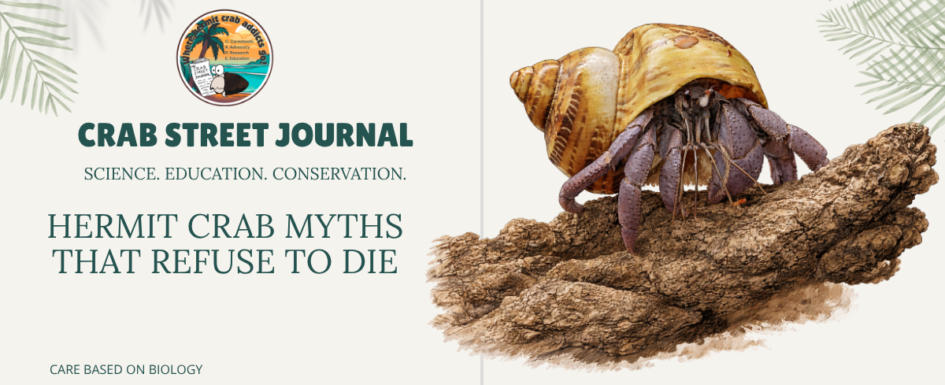
Outdated Advice Still Hurting Hermit Crabs
Not all hermit crab care advice ages well.
Some of the most common care recommendations still repeated today are not just outdated—they are actively harmful.
Many of these myths came from older care sheets, pet store handouts, and outdated beginner guides that were written long before captive hermit crab care was grounded in species-specific research, long-term observation, or modern husbandry standards.
Some of this advice is still circulating because it was repeated often enough to become “normal.”
That does not make it correct.
These are some of the most persistent hermit crab care myths still causing preventable stress, injury, and death in captive hermit crabs.
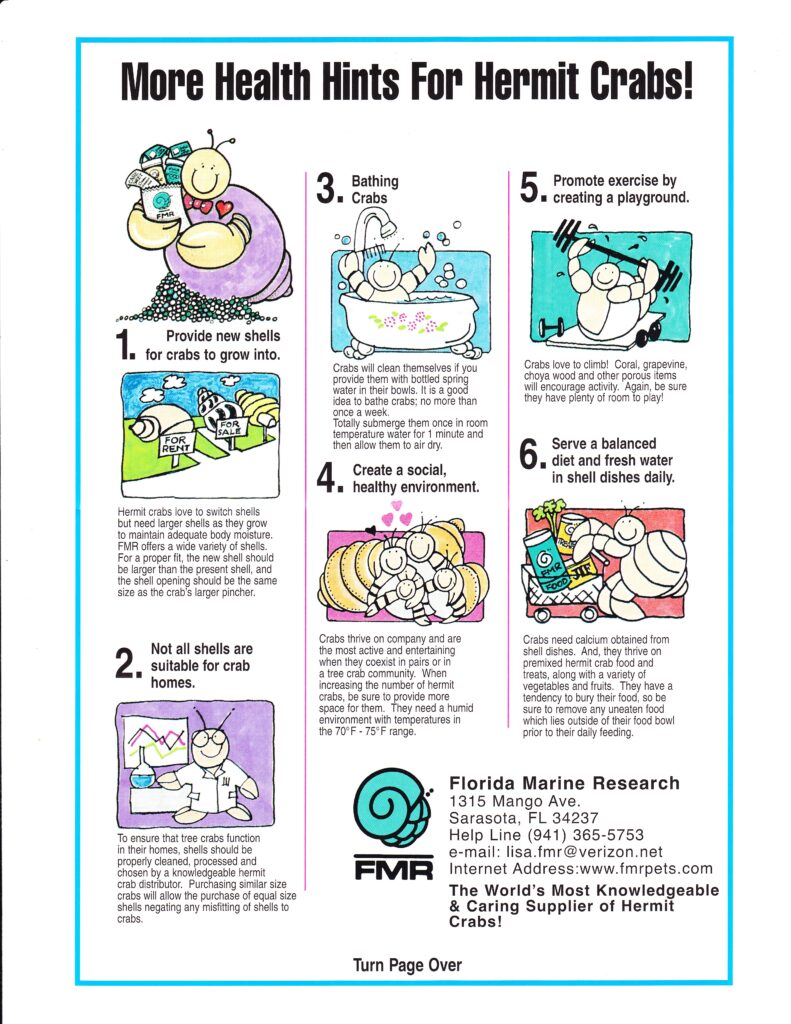
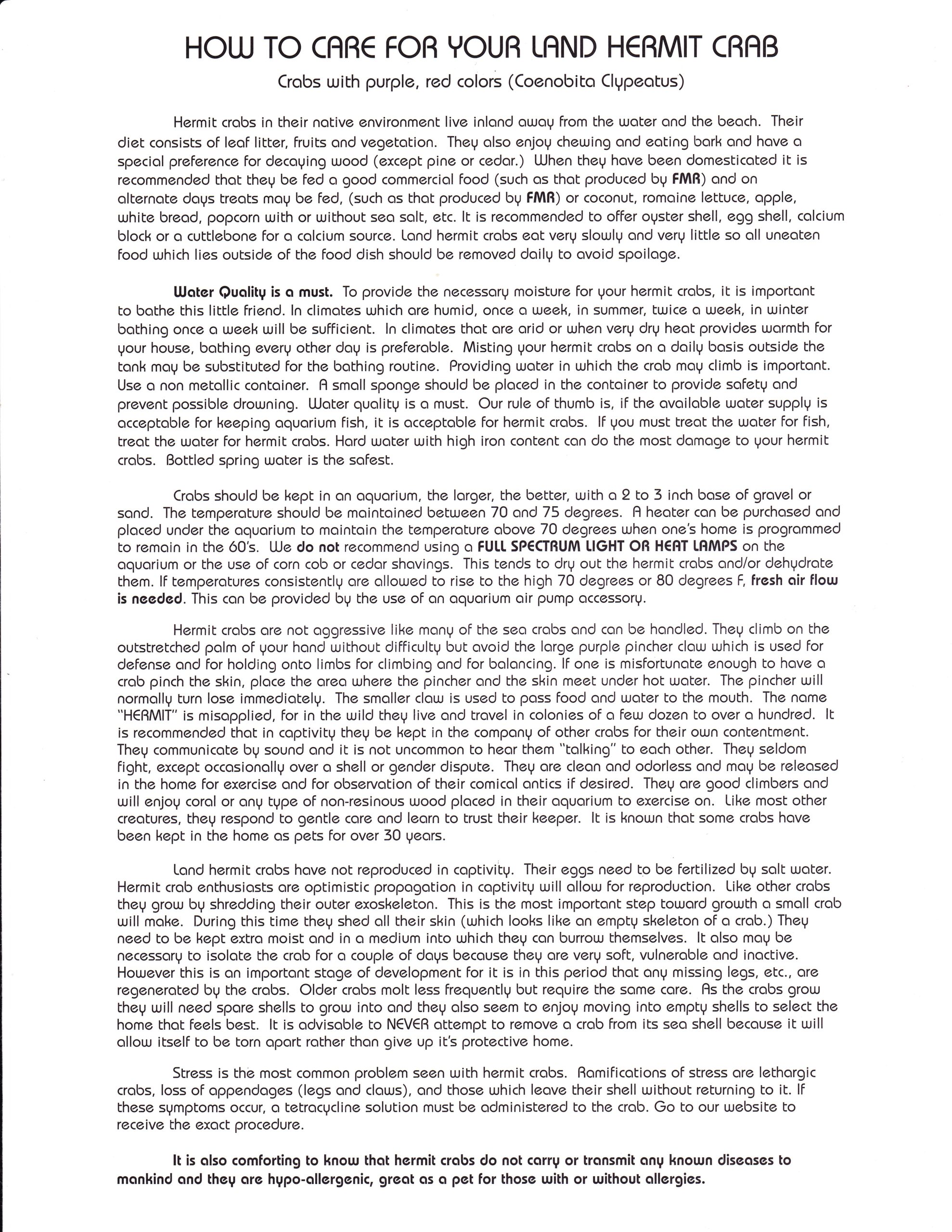
This decades old caresheet from FMR is likely familiar to you. It has been updated once in the last 20 years, but the advice remains inaccurate/inadequate.
Myth: Hermit Crabs Need Weekly Baths
This is one of the oldest and most persistent myths in hermit crab care.
Healthy hermit crabs do not need routine weekly baths.
Bathing should be situational, not routine.
Forced weekly bathing causes unnecessary handling stress, disrupts natural behavior, and may force crabs to dump shell water unnecessarily.
Baths may be useful in specific situations, such as:
- visible contaminant inside shell
- emergency rinsing
- targeted mite removal
They should not be treated like routine maintenance for otherwise healthy crabs.
Myth: Hermit Crabs Need Sponges in Their Water
They do not.
This myth likely came from outdated concerns about drowning, but healthy land hermit crabs do not need sponges to drink safely.
Sponges do not make water safer. They make it dirtier.
In most tanks, sponges quickly become bacterial reservoirs filled with food debris, waste, and biofilm.
Natural, dry sponges are safe and provide enrichment.
Properly sized water dishes with safe exits are the better solution.
Myth: Hermit Crabs Can Live in Tiny Plastic Cages
They can survive in them briefly.
They cannot thrive in them.
Small plastic “starter” habitats sold for hermit crabs are one of the most damaging products still normalized in the hobby.
They do not provide:
- stable humidity
- adequate heat
- proper molt depth & space
- safe space for social housing
- room for enrichment
These enclosures are not suitable long-term habitats.
They are confinement, not care.
Myth: Hermit Crab Pellets Are a Complete Diet
They are not.
Commercial hermit crab pellets are one of the most persistent examples of convenience being marketed as nutrition.
Many pellet foods contain dangerous preservatives, artificial colorants, unnecessary fillers, and ingredients that do not reflect the biological nutritional needs of land hermit crabs.
A proper hermit crab diet should include:
- varied plant matter & leaf litter
- animal protein
- calcium & chitin sources
- carotenoids
- fats
Pellets are not a replacement for biological nutrition.
Feed for Biology, Not Convenience
If you want to understand what hermit crabs are actually built to eat—and why so many common feeding lists get it wrong—start here.
Myth: Painted Shells Are Safe
They are not.
Painted shells are one of the most harmful products still routinely sold for hermit crabs.
The process used to create them is abusive, unnecessary, and frequently lethal. Crabs are forcibly removed from their shells, physically abused, and forced into painted replacements for decoration and sale.
Even when the crab survives the process, painted shells can:
- chip
- flake
- trap heat
- interfere with shell assessment
- contaminate food and water
Painted shells are not enrichment. They are cosmetic abuse sold as decor.
Ready to Replace Outdated Advice?
If you want a modern, biology-first approach to hermit crab care, start here.
Myth: Hermit Crabs Need Heat Rocks
They do not.
Heat rocks create localized hot spots and uneven heating that can dry the enclosure, destabilize humidity, and increase the risk of injury.
Hermit crabs need stable ambient heat, not direct conductive heat from below.
Overhead or rear-mounted external heat is safer and more effective.
Myth: Hermit Crabs Should Be Isolated
Usually the opposite is true.
Land hermit crabs are social animals and should not be kept alone long-term unless medically necessary.
Isolation is appropriate for:
- medical observation
- aggression monitoring
- quarantine
- emergency recovery
It is not appropriate as standard housing.
Routine isolation deprives hermit crabs of normal social interaction and often creates unnecessary stress.
Myth: Hermit Crabs Only Live a Few Months
They can live for decades.
The idea that hermit crabs are “short-lived” pets is one of the most damaging myths in the hobby because it normalizes poor care and predictable early death.
Hermit crabs do not naturally live a few months.
They die early in captivity because they are routinely sold into poor conditions, poor diets, chronic stress, and inadequate environments.
Short lifespan is not normal.
It is usually preventable.
Myth: You Should Deep Clean the Tank Regularly
Not routinely.
Routine full tear-downs are one of the most common forms of unnecessary stress in captive hermit crab care.
Frequent deep cleaning can:
- collapse molt tunnels
- bury hidden crabs
- destabilize heat and humidity
- destroy beneficial microfauna
- disrupt the enclosure ecosystem
Spot cleaning should be routine.
Full tear-downs should be situational.
Not Every Problem Needs a Full Tank Tear-Down
One of the most common mistakes in hermit crab care is overcorrecting.
Before you tear apart the enclosure, learn what actually requires intervention—and what usually does not.
Read: Bugs in a Hermit Crab Tank
Myth: Hermit Crabs Only Need Fresh Water
They need both.
Land hermit crabs require constant access to both fresh water and marine-grade salt water.
Salt water is not optional.
It is a biological requirement.
A hermit crab kept without access to marine-grade salt water is being deprived of a necessary resource.
Myth: If It Came From a Pet Store, It Must Be Safe
It is not.
Some of the most harmful products still marketed to hermit crab keepers are sold specifically for hermit crabs.
That includes:
- painted shells
- pellets
- tiny habitats
- sponges
- heat rocks
- calcium sand
Retail availability is not proof of safety.
Many hermit crab products are designed to sell easily, not support long-term survival.
Why These Myths Persist
Most outdated care advice survives for the same reason bad care becomes normalized in the first place:
it is easy, familiar, profitable, and repeated often.
That does not make it safe.
Many of the most harmful hermit crab care practices are not rare mistakes.
They are routine industry standards.
That is exactly why they continue to do so much damage.
Keep Learning
Still untangling outdated care advice? Start here next:
Final Takeaway
Some of the most common hermit crab care advice is still built on outdated assumptions, poor retail standards, and care practices that should have been abandoned years ago.
Just because something has been repeated for years does not make it safe.
Good hermit crab care is not built on habit.
It is built on biology.