8 Tips To Help With Humidity In Your Hermit Crab Tank!
by CRAB CENTRAL STATIONRead More →
Science Based. Ethical Choices. Better Lives.
by CRAB CENTRAL STATIONRead More →
Mold in general is universally viewed as unsafe and to be avoided.Read More →
Natural sea sponges are NOT bad for hermit crabs. In fact, they are a great food source. “But your website says not use to use sponges!” Yes. It does. However, there is some need for clarification here. The more accurate statement would be: Do not use sponges in the manner suggested by the pet store or packaging. Most pet stores and pet supply stores sell sponges as a multipurpose product. First, as a means of drinking without drowning. That, in and of itself, is amusing considering most pet stores don’t provide enough water for a fly to drown in let alone a hermit crab. HermitRead More →
A couple years ago when we created our Facebook group to go along with our website I was shocked to find so many people with flooding issues and bacterial blooms in their crabitats. The response to this was a false bottoms. In 14 years of crab keeping I’ve never encountered this, so it’s on my mind all the time…where is all the water coming from? I think I may be on the path to the root cause – overly wet substrate at the beginning. When you take sandcastle wet sand, add wet ecoearth, add bubbler pools and heat and it’s no wonder the humidity inRead More →
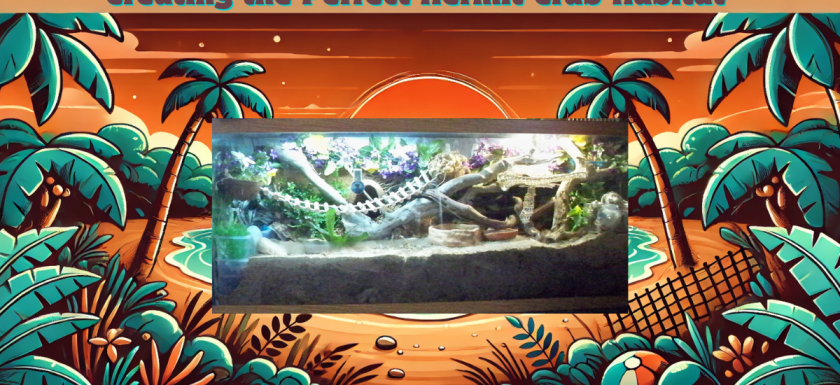
A proper hermit crab habitat is the foundation of long-term survival in captivity. Most health problems in pet hermit crabs can be traced back to habitat issues: improper heat, low humidity, unsafe substrate, poor ventilation, or lack of space. The enclosures commonly sold for hermit crabs in pet stores are not suitable for long-term care. Small plastic carriers, wire cages, and undersized novelty tanks cannot support the heat, humidity, and substrate depth hermit crabs require to survive. With the right setup, land hermit crabs can live for decades. Building the habitat correctly from the start is one of the most important things you can do.Read More →
Land hermit crabs require a properly set up crabitat to survive and thrive in captivity. Sometimes we may not be able to provide that right away or we need a temporary housing set up because we are moving to a new home or we are faced with evacuating our current home. Perhaps you just bought your first hermit crabs and have discovered that the Kritter Keeper you were sold is NOT a sufficient home but can’t afford or don’t have immediate access the proper supplies. In these circumstances you can set up a temporary crabitat. The MacGyver crabitat (ideal for emergency short term housing whenRead More →
Please note: We’ve updated our language and PPS is now called PPDS – Post Purchase Death Syndrome as this is a more accurate name. written by Sue Latell March 8, 2006 I have belonged to the on-line crabbing community for a little over 3 years now. From day one there was discussion about the number of deaths immediately occurring after purchase. It evolved into a named syndrome: PPDS. Many “unexplainable” deaths that occurred in the time-frame from newly acquired to first post molt death were labeled PPS. Time lines wavered (anywhere from one week-up to one year), and alarmingly glossed over (in my opinion) tooRead More →
This is a (hopefully) more simplified revision of the original. I have also created a printable calendar for tracking that is free to download. Introduction: The objective of this method is to reduce the impact of physical stress by keeping the hermit crab above ground eating well and exposed to light. Both are vital to the hermit crab’s ability to recover. This is a thirty day method. While this can be accomplished in three weeks, there is no reason to rush. If you are adding new (wild caught) hermit crabs to your existing colony it is important that you do not introduce sick or contagiousRead More →
written by Sue Latel March 8, 2006 Little Billy has had 3 hermit crabs since his 12 birthday. He has a 20 gallon tank housing his 3 small PP crabs. One day when he is at the store picking up some ocean salt water for his crabs, he spots a tank containing 2 poor little Ruggies that have no water except for a damp sponge, huge pellets of food that he doubts they have even attempted to eat, and no ground cover to protect them from the 100 watt heat lamp that is shining directly on them from an open tank top. Billy has been aRead More →
written by Jennifer Borgesen The fungi: how they grow and their effects on human health. (includes related article on documentation of fungal exposure and disease relationship) Date: 07-01-1997; Publication: Heating, Piping, Air Conditioning; Author: Burge, Harriet A. Shape and structure of fungi “The fungal cell is similar to that. of plants and animals, containing all of the same organelles (nucleus, mitochondria, ribosomes, membrane systems, etc.). Like plants, the fungal cell is bounded by a rigid cell wall. However, while plant cell walls contain cellulose as the basic structural material, fungal cell walls contain a material that is similar to that in insect exoskeletons (chitin). MostRead More →
written by Rai Ahmes Relative humidity (RH) is measured as a percentage–absolute and specific humidity are NOT. If it reads in % it’s a relative gauge. RH gauges are fairly inexpensive and commonly available. Gauges measuring absolute or specific humidity are hard to find and expensive; they also read in either g/kg or g/cubic meter (or the non-metric equivalent) not %. “Actual humidity” and “exact humidity” are not measurements. Dial RH gauges are rarely calibrated properly by the time they reach your home. This is NOT the fault of the manufacturer. It is simply the way it is with this type of hygrometer whether it’sRead More →
Hermit crabs are often sold as low-maintenance pets, but that is one of the biggest myths in the pet trade. They are not easy starter pets.They are not cheap.They are not short-term companions. Land hermit crabs are wild animals with complex environmental needs, specialized diets, and life spans that can exceed 30 years in captivity when properly cared for. That means bringing home hermit crabs is not a casual purchase.It is a long-term commitment to building and maintaining a specialized environment for animals that depend entirely on you to survive. For the right keeper, hermit crabs can be fascinating and rewarding to care for. ButRead More →
Originally posted at All Things Crabby Things Hermit Crab Care Blog The first step to creating and maintaining humidity in your tank, is a good lid. A screen lid alone is not sufficient. A glass/plexiglass/lexan lid, cut to fit is the best option. Plexiglass/lexan can be purchased at most hardware stores and be cut to size for free. This can be placed on top of your existing screen lid for stability. Coroplast is another good option for a lid. This can be placed on top of your existing screen lid for stability. In the short term, you can use plastic wrap over the screen lid. SomeRead More →
Originally written by Vanessa Pike-Russell-Updated by Stacy Griffith What is Humidity? Humidity is a measure of the amount of water vapor in the air. It can be expressed in several ways. “Specific humidity” is the mass of water vapor per unit mass of combined dry air and water vapor, generally expressed in grams per kilogram. The specific humidity of an air parcel does not change with temperature. “Absolute humidity” is the density of water vapor, expressed as grams per cubic meter of air. “Relative humidity” is the ratio of the partial pressure of water vapor to the equilibrium vapor pressure of water at a givenRead More →
Originally written by Vanessa Pike-Russell-Updated by Stacy Griffith There are a few reasons your hermit crab may be less active than you expected. Is your crabitat boring? One way to increase activity is to create an obstacle course within the tank, using cholla logs or driftwood, coral and/or rocks. Providing an enriching environment will encourage your hermit crabs to explore. They are curious beings and they love to climb. Land Hermit crabs are primarily, but not exclusively, nocturnal creatures. That means that in the wild they sleep during the day and are active at night. This allows them to escape the drying heat of theRead More →
2001 - 2026 © Crab Street Journal. All Rights Reserved. Unauthorized reproduction, scraping, AI training, or redistribution of content is prohibited.
Educational Use | Acceptable Use Policy | Affiliate Disclosure